Showing posts with label Tuam. Show all posts

Thursday, 12 October 2017

Extract from Ernie O'Malley Interview with Liam Langley

During the period 1948-1951Ernie O’Malley conducted interviews with around 400 of his former colleagues from the revolutionary period concerning their experiences during the time. The handwritten transcripts of these interviews are contained in 53 notebooks which are held in the UCD achives.  Liam Langley gave a number of interviews to O’Malley, the following is an extract from one of the interviews.  It is concerned with imprisonment post 1916.
Galway Jail Record

‘In 1916  in Richmond Barracks  I met Austin and Terry Mac.  Austin Stack was in another room.  He was terribly worried about the the volunteers, Con Keating, Daniel Sheehan and Charlie Monahan who had been drowned in the car in KerryDesmond Fitzgerald was also there he  was well dressed.  He was complaining about the untidy condition of the Galway men and about their being uncouth, but Liam Mellows had already warned me of what to expect from Desmond Fitzgerald.  Joe Mac Bride I met there, and we became good friends, we went to Wakefield together. For a week we had free association, but 4 of us were picked out and were put into solitary confinement in a basement in another wing of the goal.  Conor Deere of Goulds Cross Clonoulty Tipperary, Joe MacBride, Terry Mac Sweeney and myself.

Monday, 11 July 2016

Athenry Farming and Country Life 1916 Commemoration


Banners made by Anne Tierney President
Old Tuam Society for their display at the
Athenry Farming and Country Life 1916 Commemoration event.


Friday, 24 June 2016

TUAM SUPPORT FOR LIAM LANGLEY IN FRONGOCH PRISON 1916

Liam was interned in Frongoch as members of the United Irish League Tuam were seeking support to have him released at home. A report in the Tuam Herald July 1st 1916, describes how, at a meeting of the  League, held on Sunday 24th June 1916, members passed a motion seeking an amnesty for Liam and pressing on the League to put pressure on their local MP Mr Hazleton to help get him released.                
Extract Tuam Herald Article 1 July 1916
        Of concern was the fact that his mother, a widow, was now on her own as her only child was now locked up in England .Despite professing that Liam Langley had no part in the activities of the 1916 maneuvers in Tuam, many of the men present were members of the Irish Volunteers and had drilled and trained with Liam on the run up to the Rising. The Connacht Tribune also ran a similar article on the same date and described Liam Langley as a 'most respectable and decent young gentleman'.  District Inspector Comerford is the RIC inspector who, along with three others, arrested Liam at him home at 4.30am May 8th 1916.

Interestingly Mr Hazleton M.P. had been dispatched to Tuam in November 1914, in an unsuccessful attempt, to try to persuade the Irish Volunteers to abandon their position and support Redmond's National Volunteers.

The efforts of the United Irish League Tuam were not successful, Liam was removed to Reading Jail 11th July 1916 and released 24th December 1916.

     Connacht Tribune Article July 1st 1916


    Tuam Herald Article July 1st 1916

Saturday, 14 May 2016

Postcard from Richmond Barracks May 14 1916


Liam Langley was arrested at 4.30am on Monday May 8th 1916 in his home in Tuam.  He was transferred to Richmond Barracks Dublin on Friday 12 May.  This is a postcard he wrote on Sunday 14 May 1916 to his mother, Margaret, a widow, left on her own  in Tuam following her son's arrest. 

The contents of the card are very interesting as Langley makes many references to his fellow comrades from Tuam and Galway telling his mother what has happened to them.  His reference to the 'sea side' is alluding to the Volunteers who were arrested around Galway and held on the British ship HMS Gloucester which was moored in Galway Bay during East Week 1916.  


TRANSCRIPT OF POSTCARD

Wm. T. Langley (of Tuam)
C/O Officer I/C Prisoners
Richmond Barracks
Dublin

Dear Mother

Got here on Friday, things looking brighter. Asquith and Redmond here yesterday, so we are now allowed to write and receive letters and parcels addressed as above. P Dunleavy* here, yet Joe C (Cummins)* sent to England, no news of J Forde I met ??? brother from Clonmel and I see a brother of P. O’Daly** has been deported.  An officer came and said we would be allowed legal aid, so I gave him Mr H Concannon’s name, and he has been written to and may be tried on Wednesday next.  It looks as if a Good Home Rule Bill is only a question of days.  You might send me a collar & tie. How is everybody in Tuam?  Have any more been taken to the seaside? We got Mass at 11 today in the Barrack Square. Things are much better than in Galway Prison and the officers and men are as nice as can be expected.  Several men let home today.  So hope on. With best love I am yours 
                                                             Willie
                                                             Sunday 14 May 1916


*Patrick Dunleavy and Joseph Cummins were both arrested on in the early hours of Easter Wednesday morning as the Tuam volunteers were making their way to Athenry.  
John Forde (later Sean)  was born in Tuam, friend and comrade of Liam. A member of Fianna Eireann and the Irish Volunteers Forde was active in Dublin during the 1916 Rising, 

**P. O'Daly (Paddy or Patrick) spent time in Tuam 1913/14. Fought under Ned Daly in 1916. Interned in Frongoch. Later became leader of Michael Collin's Squad and Major General Irish National Army 1922-24.

Sunday, 24 April 2016

EASTER WEEK 1916

It is easy to forget that all around the country in small towns and villages Volunteers had drilled and practised for a Rebellion for more than two years.  The Volunteers in Tuam were no different, despite a depleted group following the ‘split’ and not having a great deal of local support the Tuam Volunteers still came out for manoeuvres during Easter Week 1916. MacNeill’s countermanding added confusion to the situation, communication difficulties and surveillance by the R.I.C. forced the Tuam Volunteers to disband at daybreak Wednesday 26th April 1916.  The following is an account of their activities and Liam Langley’s involvement during that week.

Barney Mellows, Gary Holohan, Sean Heuston, Liam Langley


The situation in Galway was no different to that in the rest of the country in the week prior
to Easter Sunday.  Rumours were rife that something was happening although no firm word was coming through as to what exactly the plans were. Dispatches crisscrossed the country with messages and instructions. .  One courier to arrive in Athenry was Margaret Brown (later Mrs Sean McEntee) who came on Holy Thursday with a dispatch from Sean MacDiarmada (WS322).  Witness statements suggest that the plan was to take control of local RIC barracks and to use the captured weapons in any ensuing military action.

According to John Hosty’s statement there was confusion over the order, a meeting was held of commandants and captains of the Irish Volunteers (all were also IRB members) to decide what to do, Liam Langley (Centre, IRB Circle North Galway, O/C Tuam Company, Galway Brigade IV, VP Na Fianna Éireann)  was in attendance. John Hosty was dispatched to Dublin on the mail train at midnight to see Eoin MacNeill (Irish Volunteers) and confirm whether the order was genuine or not. However George Nichols (Solicitor and IRB Centre Galway) secretly requested Hosty to go straight to Pearse and advise him what was happening in Galway and get clear instruction as to how to proceed (IRB) (Hosty, WS373). However by Saturday night most battalions in Galway were aware that they were being called out for major muster on Easter Sunday.  
Eoin MacNeill’s subsequent countermanding on Holy Saturday night put a stop to activities. His message was published in the national papers on Easter Sunday morning, it read, ‘all parades of Volunteers arranged for the weekend were cancelled’.  On Saturday evening/night dispatches were also sent around the country by McNeill with the order.  McNeill’s order led to confusion and uncertainty in Galway, Tuam and around the country in general (Dunleavy, WS1489).    

Wednesday, 13 April 2016

Irish Volunteers Tuam 1914

Tuam Battalion Irish Volunteers drilling in Parkmore Tuam 1914 under
S. Shaughnessy & P. Flanagan


Liam Langley left almost at end of the line with 'straw hat'


Handwritten caption by Liam Langley

Friday, 11 March 2016

Liam Langley Released from Reading Jail Christmas 1916


On Christmas Day 1916 Liam Langley and fellow prisoners from Reading Jail arrived in Kingstown Harbour (Dun Laoghaire).  Liam and the internees from the West did not make it home in time for Christmas Day.  This was hard on Liam's mother, a widow with an only child and now on her own in Tuam for Christmas.

The Irish Independent of 26 December 1916 reported that during the three weeks before their release many of the prisoners had been unwell suffering from flu like symptoms. 

The men were only told on Sunday afternoon, Christmas Eve, between 2 and 3pm, that their release was imminent, until this time they had no idea of what was coming. They had expected to spend Christmas in prison and had prepared for this event.  Once news came through of their release they wasted no time and packed up their few belongings.

Buses brought the prisoners to Paddington Station, London,  a journey today of just over an hour, but in 1916 it probably took almost two hours by bus. Here, they changed bus and then headed across London to Euston Station.  Shortly before 8pm they left Euston Station by train and made the 3am sailing from Holyhead, arriving in Kingstown, Dublin at 6.30am.  They then boarded a train to Westland Row station where large numbers of people turned up to greet them.  

Many well known prisoners were released in this group along with Liam Langley, these included: Sean T. O’Kelly, T.C.; P.T. Daly, T.C.; Arthur Griffith; Henry Dixon; Padraig O’Maille, Connemara; Ex-Ald. W. Cole; Peter M. Sweeney, Loughrea; Albert Cotton, Belfast; Terence McSwiney, Cork; , Joseph McBride, Mayo; Capt Morkan; George Nicholls, Galway; Cathal O’Shannon, Belfast; Darell Figgis, Achill; Ernest Blythe, Belfast; John J. Scollan, Dublin; Sean Milroy, Dublin; Seamus Reader Robinson, Glasgow; Seamus Robinson, Dublin; and Joseph R. Robinson, Glasgow.                                                                 

Crowds at Westland Row Railway station welcoming home the internees                                           Christmas 1916. Photo National Library of Ireland               

Irish Examiner 27 Dec 1916

Wednesday, 3 February 2016

John Redmond and the Irish Volunteers Tuam

In September 1914 after John Redmond calls on the Irish Volunteers to join the British army, the movement splits with those following Redmond becoming the National Volunteers.  The Irish Volunteers in Tuam were under tremendous as support for Remond's volunteers gathered across the country.  Resistance in Tuam however remained strong with meetings being organised to encourage members to resist enlisting.  Major John McBride was one speaker who came to address the Tuam volunteers in November 1914 in this regard.  In collaboration with Bulmar Hobson Liam Langley organised this address (recorded memoirs Liam Langley).   Michael J Ryan, (WS 1320, Captain Bernaderg Company, Tuam Battalion, Irish Volunteers 1916) recalls a meeting held in the town hall in relation to this matter, this is more than lightly the same meeting which was addressed by McBride:

' I remember the Home Rule Bill being shelved and John Redmond asking the Volunteers to fight for Ireland in France. I remember a meeting of the Tuam Company being held in the Town Hall, Tuam, sometime in 1915 (
more than lightly late 1914). The company was paraded and addressed by, I think, Martin Joseph Walsh, who put the Redmondite point of view to them. Liam Langley, afterwards 0/C of a Fianna battalion in Dublin, and William Cannon addressed the company and put the anti-Redmondite point of view before them. I remember the division of the company very well, those in favour of Redmond going to one side of the hall and those against going to the other side. I can remember that very few of the company went to the Redmond side. The majority went to the anti-Redmond side after Langley's and Cannon's address. Of those who opted for the Redmond side, very few actually joined the British Army.

Article from Irish Volunteer Dec 1914

PRESSURE INTENSIFIES 

On another occasion two members of the Irish Parliamentary Party were sent to Tuam to try their luck with convincing the local volunteers to enlist, but they too were met with resistance (see article right).  Liam Langley also recalls their visit in his recorded memoirs.  Major McBride was again in town meeting with Langley the night the two MP's were in town.  Langley and McBride were in Guys hotel when they came across the two MPs, Hazleton was representative for North Galway, while Lundon was representative for Limerick.  The  account in the Irish Volunteer newspaper December 1914 suggests the two men returned to Dublin with no success in changing the minds of the Tuam Volunteers.

In December 1914 Mr.John Redmond, Irish Parliamentary Party leader, arrived in Tuam, he addressed a meeting in the town in which he said that the response of Irish nationalists had been gallant and that any suggestion of a refusal to enlist was ‘shameful and dishonest.’ Redmond's address brought about the desired result in the town and recruitment to the National Volunteers started in earnest. 

Michael J. Ryan (above) also recalls this meeting: 

' I remember that John Redmond came to Tuam in 1915 (should be Dec 1914) and addressed a very big parade of Irish Volunteers who assembled there from all parts of County Galway. He spoke from one of the windows of Guy's. Hotel. I remember distinctly that the Tuam Company of the Volunteers did not take part in the parade. I think that the meeting was a recruiting meeting for the British Army rather than a national political meeting.'


Liam Langley in his witness statement elaborates on the aftermath of 'the split' in the Volunteer movement in Tuam:

'At that time things had begun to go badly with the Irish Ireland Movement in Tuam as elsewhere in the county. After a very successful three years during which were established troops of Fianna Éireann, Circles of I.R.B. and a Corps of Irish Volunteers, an opposition element began to show itself. Encouraged by a recruiting campaign launched by the Irish Parliamentary Party on behalf of the British Army, enemies emerged from everywhere. Pastors, parents, merchants and employers were approached and pressed to withdraw support from the national organisations. Cases were reported where they went even further, a Fianna uniform, the property of the organisation, having been burnt to ashes by the employer of the Fianna boy concerned. They partly succeeded in breaking up the local branch of the Gaelic League when the Secretary was wrongfully impeached with leading a protest demonstration during a visit of representatives of the British Lady Lieutenant Aberdeen on a lecture tour connected with the W.N.H.A. 2.

Further instances could be given of open hostility to everyone with Irish Ireland sympathies. What was once a stronghold of the Independence Movement was rapidly becoming a pro-British garrison town. Great Southern railway officials were warned and ordered to leave the Irish Volunteers or else - . Open parades of the bodies could not be held and we were compelled to use the machinery provided by the I.R.B. to run the organisations'  (Witness Statement WS0816 BMH)

Monday, 1 February 2016

Reports from Irish Volunteer regarding progress of Irish Volunteers in Tuam

The following reports were written by Liam Langley and published in the Irish Volunteer paper. 


(See I.V. 7 March 1914 Tuam meeting 350 recruits for I.V. See letter from Colonel Moore not included)

Extracts from the ‘Irish Volunteer’ ? March 1914  
On Sunday week, the Tuam Company, Irish Volunteers assembled for Drill at Sloyan’s yard, when it was seen that the ranks were much augmented by new recruits under Mr Phillips (who in future is to rank as Captain) and his staff of instructors: Messrs Kennedy, O’Shaughnessy and O’Flanagan.  The men were put through an hour’s drilling.  They were handled in squads of 24 each and kept going without intermission for the full hour.  The men entered seriously into the spirit of the work and their earnestness augurs well for the future of the movement in Tuam.  Let us hope for a daily increasing growth in the discipline and morale of the Tuam Corps, as it will take yet a little time to nail the assumption that this is but a transitory movement and will not endure.  Passing events justify its existence more and more, and those at the head of affairs here in Tuam were determined to try and bring the local corps to battalion strength and in a position to vie with the strongest centres elsewhere.

After drill the Volunteers marched in regimental formation to the Town Hall, where a meeting was held for the purpose of appointing a committee to manage the affairs of the corps.  Here the same spirit was again evident and much useful preliminary business was dealt with.  The following committee was appointed:- Doctor T.B. Costello, President; James Daly, T.C. Treasurer; W.T. Langley, Hon. Secretary; Committee:- Messrs John Burke, T.C., Wm Stockwell; Sam Browne, Denis Creedon, Tomas MacAodh, James Gordon, D.J. Butler, Padraigh O’Dalaigh, James Roche, Wm. Cannon.  Captain Phillips, Messrs. Michael Kennedy, Stephen O’Shaughnessy and Dan. Flanagan were appointed ex.-officio members of the committee.

The president addressed the members as did Captain Phillips and each was listened to with rapt attention.

Dr. Costello emphasised the necessity for individual effort by each member in maintaining the dignity, efficiency and thorough discipline of the corps.  The members must bear in mind that there is no personal gain to be made by any of them; there was no land to be given away or documents of any kind to be offered.  The Volunteer movement was based on the principal of pure patriotism, and instead of seeking gain of any kind members must be prepared to suffer for their country.
The enclosure of Parkmore, which has been kindly lent by the Race Company will, in future, be the rendezvous of the Volunteers.

Vol. 1 No. 28 March 28 1914
The Tuam Company, Irish Volunteers enjoyed a brisk hour’s drilling on Sunday the 15th inst. under Capt Phillips.  The new rendezvous, Parkmore enclosure, although somewhat sloppy under foot, is a vast improvement on the old place of drill, which was too small.  The weather on Sunday was somewhat favourable, yet there was a good muster of 70 men.  A U.I.L. meeting in the Town Hall detained a many members who would have otherwise considerably swelled the ranks.  As it was, those present had an invigorating time of it and made marked advance in proficiency.  The instructor was highly pleased while the men expressed themselves delighted with what was to them a pleasing and beneficial form of exercise.  Of course perfection is far from being achieved so far; indeed it will take some months before Tuam Corps approaches anything like the precision, bearing and perfect mobility of regulars; but then it should be realised that the fully trained soldier in any army must undergo a rigorous daily course of drill from 4 to 6 months duration before he is allowed to pass into the regimental unit.  From next week onward the Tuam Corps will be divided into sections so, as to facilitate a more rapid advance in drill efficiency.  Each section will be placed under the care of competent instructors and care will be taken that each section, as it perfects itself will be kept together and trained to the fullest extent.  New arrivals will be kept in separate squads until efficient enough to fall into the regular body.  Now that the evenings are lengthening certain weekdays will be apportioned to each section for drill, with full parades every Sunday and frequent route marches at intervals.  The pattern of rifle for general use throughout the country is not yet decided on by the Provisional Executive, but the moment it is chosen the matter of arming the men will b at once gone with.

(Vol. 1 No 9 Sat 14  April 1914 See Letter from P.J. O’Flanagan)

(Vol 1 No 10. April 1914 ‘Report from Tuam &C. held over).

Vol 1. No. 11 April 18 1914 Report as follows:-
Drill took place as usual at Parkmore on Sunday under Commander Phillips and instructors O’Shaughnessy and Kennedy.  The full Company turned out and a very pleasurable hour was enjoyed.  The Company marched to the Town Hall, where a discussion on ways and means took place, along with the necessary taking in of a little money.  It is pleasing to record the passing of each week leaves stronger confirmation of the fact that the Tuam Company has come to stay.  It is only now that the spirit of fellowship is becoming evident and earnest among the men, each of whom vies with the other in professions of loyalty to the aims and objects of the Irish Volunteers.
Company orders as usual for Sunday next, viz. muster at 12.30pm and fall-in at one o’clock at Parkmore.

A meeting of the Volunteer Committee was held in the Town Hall on Tuesday evening, Dr. T.B. Costello in the chair.  It was decided to take part in the tercentenary celebrations of the Battle of Clontarf at Dublin, and that haversacks be provided in the meantime, the question of full uniform be deferred until instructions be had from the Provisional Committee.

Liam Langley

Tuesday, 12 January 2016

Account Na Fianna Sluagh Tuam in The Irish Volunteer Newspaper Feb 1914

The Irish Volunteer First Edition 7 Feb 1914 Page 12
Account of Fianna Éireann John McHale Sluagh Tuam

On 7 February 1914 The Irish Volunteer movement launched its official newspaper titled The Irish Volunteer. The Irish Volunteer was a weekly newspaper mainly aimed at the membership of the Irish Volunteer organisation.  Along with providing news and political commentary, it had an important official function in disseminating official orders and announcements.  Developments of Na Fianna are given on page 12 of the first issue.

Liam Langley was a founder member and organiser of the Tuam Fianna Sluagh. The Tuam Sluagh was one of the first to be set up outside Dublin,, it was set up in 1911.  A report on the Sluagh written by Liam appeared in the newspaper of 7 Feb 1914:

The Irish Volunteer 7 Feb 1914
'The Tuam Fianna, called after JohnMcHale, are also making good progress.  A big sports, comprising 16 events, including the 100 yeads championship of Connacht, were brought off last October and proved a great success.  The sports for the year are now being organised, it being intended to hold them earlier in the year, probably during May.  A dramatic class is a great feature of this Sluagh, 'The Eloquent Dempsey' being the last piece staged.'

In his papers Liam Langley adds that 'An Examination Board consisting of Captain Padraic O'Riain, Lieutenant Sean MacAodha, Lieutenant A. De Faoite and the organiser (Liam Mellows) have been appointed to examine the boys throughout Irealnd in the Fianna Tests in order to secure uniformity.'

The full first edition of the newspaper can be accessed here.

Monday, 11 January 2016

Na Fianna Éireann Activities Tuam


Liam Langley was a founder member of Na Fianna Tuam, and continued to organise and train the Sluagh. Some of these activities are outlined in the reports below. In the year 1915/1916 Liam was Vice President of the Fianna organisation in Ireland.

The following reports were written by Liam Langley and published in the Irish Volunteer paper.


Report on Na Fianna Sluagh John McHale, Tuam Irish Volunteer Vol 1 14th March 1914

‘The above held an interesting debate in ‘Freedom’ Hall, Tuam on Sunday 22 February 1914 at 8pm.  The subject was ‘The Fianna promise and to keep it’, the first of a series to be continued until the summer season calls the members once again to their natural element, the open air.  The proceedings were opened by the president.  A short concert then followed in which many of those present took part.  Before dismissal the members were reminded that drill took place on Wednesday and Friday evenings; football practice on Sunday mornings; route marching in uniform on Sunday afternoons and debate and concert on Sunday night, a record of the attendance of each member being accurately kept.  ‘Our Duty to Motherland’ was fixed as the subject of the next debate’ 

A further report is noted in a later edition of the paper:

'The members of Tuam Fianna have started the season’s work in earnest.  On Sunday week over thirty assembled for football on the Drill grounds at 10.30am where after match after match was played until 2pm.  At 3.30pm the Fianna left Tuam for Cloonasgra in two companies, one under the leadership of the President and the other under the command of Captain P. O’Daly; No. 1 Company arriving on the battleground half an hour before No.2, the enemy garrisoned on the hill, run up their colours, placed look-outs, and after taking cover cautiously approached the hill from different directions.  After half an hour’s fighting, several men having been lot on either side and many prisoners taken, the garrison was over-powered, the colours taken and the No.2 company declared victors.

An interesting debate took place in the Fianna Hall after Vespers, the subject being ‘Ireland’s and England’s Heroes: a Comparison’, P. O’Daly dealing with the first part and A. Leneghan with the second.  Such things as the recent Wexford Lifeboat tragedy, the Sidney Street battle and the baton charge in Dublin on Black Sunday came up for discussion.  The ranks are swelling and it is up to the boys of Tuam to stick to such a worthy organisation as the Fianna.'

Cover courtesy of Dublin City
Library on line collection


Guidelines for training Na Fianna were issued from Headquarters in Dublin.  This Fianna Handbook contains an introduction by one of the founders of the organisation Constance Markeivicz.  Instructions on drilling, handling a Lee-Enfield, first aid, and scouting are contained therein.

Notes on Na Fianna Training from Irish Volunteer December 18th 1915

Saturday, 19 December 2015

An Evening of Entertainment Tuam December 1915

The Connacht Tribune 1 January 1916


Despite the fact that membership in the Irish Volunteers was severely depleted and they had to train almost in secret in Tuam following the split in the force, the support for nationalism was still evident in Tuam (Langley WS805).  Local organisers, including Liam Langley, ran events under different guises.  One such event is recorded in the Connacht Tribune on 1st January 1916.  They report that an 'entertainment' event was held in the Town Hall under the 'auspices of the Tuam Sports Committee' on 19th December 1915.  Irish dancing, recitation, a short drama, and musical performances were all on the programme for the the evening.The local Stockwell sisters were active in performing that evening.  There were a number of performers  from Athenry who had obviously come to support the 'Irish Ireland' cause in Tuam.  Liam, showing his cultural interest in Ireland, had a part in the short drama and recited a poem 'Brian Boy McGee' by Ethna Carbery.  

To the right is the full newspaper account of the evening's entertainment


The Connacht Tribune Front Page
1 January 1916

Sunday, 13 December 2015

Setting up The Irish Volunteers Tuam Feb 1914


Notice sent by Liam Langley inviting people to a meeting to discuss setting up the Irish Volunteers in Tuam 1st February 1914.  The Irish version of Liam's name, U (Uilliam) T. O' Laonglach was used on this notice.


Liam Langley often wrote up extracts of interest relating to the progress of the Fianna and the Irish Volunteers in north County Galway from various publications.

The following is an extract from 'The Irish Volunteer'  of  21 February 1914.  An account of the above meeting is recorded in this extract.

At a Volunteer meeting held on Sunday, 8th February 1914, the following were present: Messrs Butler, Stafford, O’Malley, Nolan, and Walsh, representing the A.O.H., Messrs Burke, Stockwell and Fahy, representing the I.N.F.;  Messrs Hare, Browne and Creedon, the G.A.A.;  Mr T. Sloyan, The U.I.L., and Messrs P. Daly and W. Langley, Na Fianna Eireann; Dr. T. B. Costello, Messrs McHugh, Donnellan, Cannon, Mullins, Roche, Kennedy, Forde & co.

Dr Costello presided and explained the business of the meeting.

Mr. Sloyan, the Secretary of the North Galway U.I.L. said that the League would back the movement to a man, and he added that he was sure the same spirit was abroad in Ireland today as that which fought in Clontarf, at the Yellow Ford and on the field of Fontenoy and which started the Volunteer movement in 1782, and he urged them to go ahead in Tuam and fall in with their rest of their countrymen.

A committee was then formed to start the Volunteers in Tuam on a firm basis. (Vol. 1; No. 3; 21 February 1914)

A.O.H Ancient Order of Hibernians
I.N.F. Irish National Foresters
G.A.A. Gaelic Athletic Association
U.I.L. United Irish League

Saturday, 5 December 2015

Tuam Stars GAA Club and the Irish Volunteers March 1914


Tuam Stars Gaelic Football Team
Liam Langley standing left in suit and hat.
In the absence of photocopiers and scanners Liam often typed up items and articles that interested him.  He typed up many extracts from the 'Irish Volunteer' relating to the progress of the Fianna and the Irish Volunteers in North County Galway.

Extract from the ‘Irish Volunteers’  Vol.1, No. 8 March 28 1914

Tuam Football Club Enrolls

A meeting of the above club was held in the Town Hall on Friday March 13th.  In the absence of the President, Mr. P.M. Ryan, the chair was taken by Mr. Denis Creedon, V/P. Also present:  Messrs. F.Fore, M.Naughton, Tom Nipton, Tom Commins, E. O’Connor, T. Ryan, Frank Farrell, James Burke and W. Cannon, Hon. Sec.

The following resolution was passed on the motion of the Secretary seconded by the Chairman:-
“That as the National Volunteer movement in its contribution and aims merits the support of every member of the G.A.A., it is henceforth made a rule that every member of the Tuam Star Football Club shall become a member of the Tuam Volunteer Corps, attend its drills and bear arms in pursuance of its objects”.

After some discussion it was decided to hold the next meeting in the Town Hall on Friday evening at one o’clock.


Na Fianna Éireann Football Match

Na Fianna Éireann Tuam
going to a match
Photo from Tuam Stars: 
Thomas Nohilly (WS1437) in his witness statement recounts the journey from a Fianna Éireann match, perhaps this is the team on the cart above!


'We travelled about a good deal to football matches and concerts, and on those journeys we were always followed by two members of the R.I.C. on bicycles.  On one occasion, after a football match in Dunmore, we were returning to Tuam by brake, accompanied as usual by two R.I.C. on bicycles.  One of the two hung on to the brake as he cycled along, to hear what was being talked about, but one of our number carrying the tricolour hit him with the flagstaff until he was forced to let go of his hold.' 

Friday, 4 December 2015

Na Fianna Éireann Ard Fheiseanna

Na Fianna Eireann Ard Fheis July 1913
Liam Langley standing 3rd to left of Countess Markievicz
Behind Sean Heuston

Close up of Fianna Ard Fheis 1913
Liam Langley 2nd row with girls hands 
on his shoulders standing behind 
Sean Heuston


Na Fianna Eireann Ard Fheis
July 1915 Mansion House Dublin
Laim Langley second row seated fourth
from left arms folded


Ard Fheis 1915
Left to right Barney Mellows, Gary Holohan
Sean Heuston, Liam Langley


Ard Fheis 1919
Liam Langley middle row standing 2nd from rigtht


Wednesday, 2 December 2015

Activities of Tuam Company, Tuam Battalion, Irish Volunteers, Co. Galway, 1914-1916

Liam Langley was a central figure in the preparation leading up to and the maneuvers in Tuam during Easter Week 1916.  An account of their activities is given in the Witness Statement 1437 of Thomas Nohilly,  Company Captain. Battalion Adjutant.

My first association with the national movement was in the year 19l14 when I joined Fianna Eireann in Tuam. Liam Mellows was the first organiser of the Fianna in Tuam, and when he had complete the organising work, Liam Langley, afterwards head of the Fianna in Dublin, took charge. Our strength was about thirty-five, and the majority were apprentices serving their time as shop assistants in various business houses in the town. We did our training about a mile outside the town, near the village of Cluainthoo, in a field owned by William Concannon who charged us no rent. Our training was under the supervision of Liam Langley, and consisted of some foot drill and arms drill with .22 rifles. We also had target practice once a week with the .22 rifles. We organised football matches and sports meetings. At one of our sports meetings in Tuam, I remember that special trains were run from Galway City, Gort and Claremorris. I remember that, on this occasion, Larry Lardner from Athenry afterwards one of the leaders of the County Galway Volunteers during Easter Week 1916 was handicapper. We had a revolver as one of the prizes.

Meetings of the I.R.B. were held in Connolly's forge in High Street. I cannot remember anything of the meetings except that Liam Langley presided at them. As far as I know, he was head centre for the whole North Galway area. Other members of the I.R.B. I remember from that time were Thomas Kilgarriff, afterwards Brigade I.0., North Galway brigade, Con Kennedy of Dunmore and John Costello of Killower, and two brothers named Connolly who owned the forge where the meetings were held.
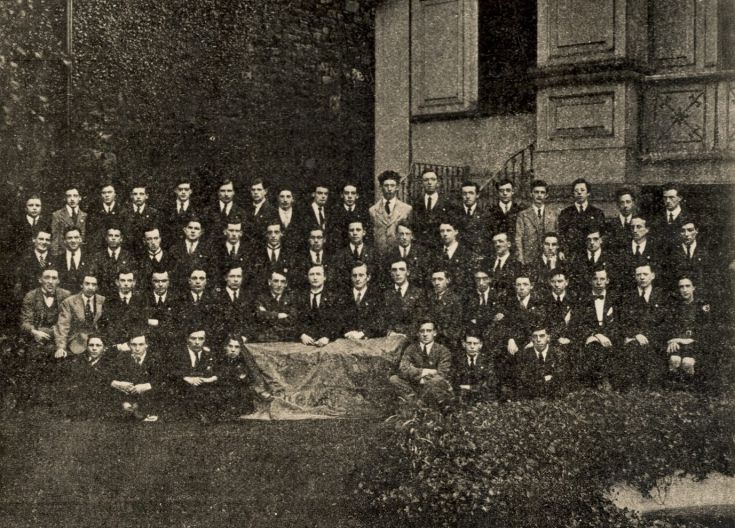
Sunday, 22 November 2015

Na Fianna Tuam Sluagh Visits Dublin c.1913

Sean O'Neill in his witness statement recounts a visit to Dublin of the Tuam Sluagh Na Fianna Éireann organised by Liam Langley (WS1219):

'Under the leadership of Liam Langley about twenty of us went to Dublin. When we reached the city and saw O'Connell's tower as we passed Glasnevin and the big buildings, it was an awe-inspiring sight. Our guide insisted that we must see the monuments. We saw a great bulky man with a cloak on him on an edifice in Sackville Street who we were informed  was "O'Connell, the Liberator". Burke and Father Matthew were here too and Oliver Goldsmith.  Parnell was impressive. His dignified demeanour and with his right hand extended seemed to greet us. The towering pinnacle of Nelson - the one-eyed English Admiral, was a challenge to all this, and we felt we could have blasted him out of the centre of the city!

It was only when we reached the home of, Countess Markievicz of Rathmines, that my mental equilibrium returned to normal. Here all of us from Tuam were entertained and put up for the night. And as that vivacious lady conversed with us, and principally with our leader Liam Langley, we felt we were in a sort of paradise.  I can recall one memorable remark, "I hope the day is not far distant when I shall see those Red Coats swept into the Liffey".

Liam Langley (top)
Con Colbert
1913
Indeed, before we met the Countess we saw scores of those red-coated soldiers sitting on the Liffey wall or hanging over O'Connell Bridge, or swaggering around, cane in hand, at street corners in their gaudy dress of Saxon red. Our Chief Scout - Madame – kept the Tuam Sluagh enthralled with her conversation and stories. I clearly remember the face of James Connolly there. He was pointed out to me by Liam Langley.

During our stay in Dublin we visited Fianna Headquarters. Here we met Con Colbert. To me Colbert was, what I might term, a keen, energetic sort of genius who meant business, business without frills.  Seán Heuston we also met, and with his genial smile he greeted us, and happiness radiated from his countenance when we entered the office. They were both in Fianna uniform.

We also  held a picnic on the Hill of Howth overlooking that beautiful bay.


At night we attended a concert in the Mansion House. And here I saw for the first time a man smartly dressed in Volunteer uniform. For no other purpose, I presume, than to show himself or, more precisely, his uniform he stepped out smartly before the footlights and got a thunderous applause. His uniform was, I think, of dark green material made up in the fashion of an American or Canadian outfit. A pair of green puttees and Sam Browne belt completed his attire. The Volunteer Officer (or Private) was, I think, Pierce Beasley.'


Barney Mellows, Gary Holohan, Sean Heuston, Liam Langley
1915 Na Fianna Ard Fheis

Wednesday, 11 November 2015

The Rising in Galway 1916 - Interview on RTE's Féach

An interview Volunteer Sean Concannon, Claregalway broadcast on RTE in 1970. It was on the prgoramme Féach and is concerned with activities in Galway during Easter Week 1916.


Thursday, 14 May 2015

Statement Arrest Sean MacDiarmuid Tuam May 1915

Liam Langley's statement to the Bureau of Military History 1913-1921 in relation to the arrest of Sean MacDiarmuid.  This is the only statement Liam gave despite being involved in activities from the early 1900's up to the end of this period.  He maintained a dignified silence in relation to his involvement.  However a careful reading of this statement gives an insight into the difficulties encountered by the Nationalist movement in Tuam following the split in the Volunteers in the time preceding the 1916 Rising