
Na Fianna Eireann Ard Fheis July 1913
Liam Langley standing 3rd to left of Countess Markievicz
Behind Sean Heuston

Close up of Fianna Ard Fheis 1913
Liam Langley 2nd row with girls hands
on his shoulders standing behind
Sean Heuston
 |
| Na Fianna Eireann Ard Fheis July 1915 Mansion House Dublin Laim Langley second row seated fourth from left arms folded 
Ard Fheis 1915
Left to right Barney Mellows, Gary Holohan
Sean Heuston, Liam Langley
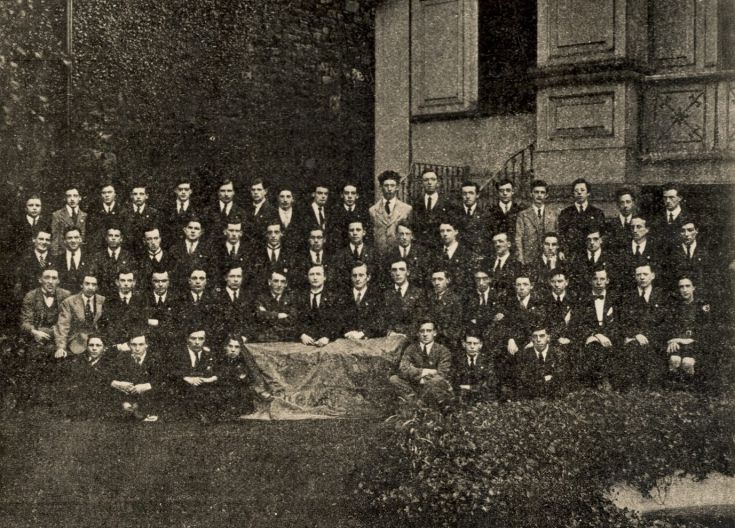
Ard Fheis 1919
Liam Langley middle row standing 2nd from rigtht
|
Showing posts with label Post 1916. Show all posts
Showing posts with label Post 1916. Show all posts
Friday, 4 December 2015
Na Fianna Éireann Ard Fheiseanna

Saturday, 21 November 2015

Friday, 20 November 2015
Na Fianna and Volunteers Composite Council 1920
As the War of Independence escalated it
was recognised that a common military policy would be of benefit to both the Volunteers (now the official army of the Republic) and Na Fianna. Negotiations between the
Department of Defence and Fianna Headquarters Staff resulted in an
agreement between the two groups in December 1920.
As a result of this
agreement a Composite Council was set up comprising three G.H.Q. Officers of
the Fianna - Barney Mellows,
Adjutant-General, Garry Holohan, Q.M.G. 0/C. Brigade and Liam Langley,
Director of Organisation; and three G.H.Q.
Officers of the Irish Volunteers - Dermot
O’Hegarty, Gearóid O’Sullivan, and Bob Price. The function of the
Composite Council was to ensure smooth co-operation between the Volunteers and
Na Fianna. The meetings of the composite council were presided over by the Minister for Defence, Cathal Brugha, or someone nominated by him.
It also discussed in detail the practical implications of the partnership, agreeing procedures which were circulated to all companies by Fianna’s Adjutant General, Barney Mellows. Within a month of the companies receiving Mellows’ memorandum the British had captured documents of Collins that referred to the Council decisions and were aware of the imminent ‘linking up’ of the two organisations.
 |
| Account of Composite Council typed and signed by Liam Langley |
Witness statements Joseph Reynolds WS 0191 and Gearoid Ua h-Uallachain WS0336,
John Watts, A Case Study of a Political Youth Organisation Na Fianna Éireann, University of Glasgow.
Wednesday, 18 November 2015
FIANNA May 1926 Mellows Commemoration Number
The Fianna was a magazine issued by Na Fianna Éireann. After a four year lapse a copy was issued in May 1926 in an attempt to resurrect the publication. This was a 'Mellows Commemoration Number'. At this time Liam Langley was on the Central Executive of the organisation, Constance de Markievicz was the Chief Scout. Included in this issue is an article on Page 2 by Constance de Markievicz regarding Liam Mellows, there is also a poem dedicated to Mellows written by de Markievicz on Page 3. Below are images of the issue, the articles and poem.
 |
| Cover |


Extract from Fianna May 1928 - Article and Poem written by Constance de Markievicz honouring Liam Mellows:
Monday, 16 November 2015
Liam Mellows Graveside Oration by Liam Langley 1928
 |
| Liam Langley Chief Scout Na Fianna Éireann |
 |
| Liam Langley Chief Scout Na Fianna Éireann giving the oration |
In his oration Langley describes when they were told of the executions in Mountjoy Jail December 8th 1922:
'On the morning of December 8th myself along with other prisoners of war were awaiting the arrival of their guards in their respective divisions of the prison. We were looking forward to the usual meeting of Liam and our comrades in the prison chapel. Little did we know what the volley we heard earlier signified. We were soon enlightened, for in a few minutes it was announced from the Altar that "four of our comrades had just been sent before God". And when the names were read out, there was a deathlike silence. It was some time before the full purport of the announcement was realised. It was then that strong men sobbed and little boys with clenched fists vowed vengeance. Men like him would never be forgotten, those who devoted their lives to their's country's service and remained faithful to the last. Liam's life may be summed up in his motto: "out to fight, not to run away". He had given his life for the love of the land that bore him'. (Liam Langley Na Fianna Éireann Chief Scout 1928)
 |
| Irish Independent 31 May 1928 This is an extract from the full article written by Liam Langley (Newspaper Cutting Eamon Murphy - History of Na Fianna Éireann) |
Full details of the article written by Langley can be read below:
Sunday, 1 November 2015
REMOVAL OF BANNER FROM GPO APPEALING FOR RECRUITS FOR THE BRITISH NAVY
Extract from Statement Gearoid Ua h-Uallachain (Gary Holohan) Fianna Éireann Dublin Brigade.
Liam Langley, along with a group of Na Fianna members, was involved in the removal of a British Navy recruiting banner from the columns of the GPO around 1918 (date uncertain). This story was often recounted at home by Liam to his family. He added that the following day a large crowd gathered to look a the burnt banner. Liam and the group cycled back into O'Connell Street to survey the outcome of their actions.
The following is Holohan's account of the incident: "There is just one incident that comes to mind which took place after 1916. As if to add insult to injury, the British authorities erected a large scroll or banner of bunting across the top of the columns or the G.P.O. on which was painted 'An appeal for recruits for His Brittanic Majesty's Navy'. This was too much for us, so we organised a party of the Fianna. There were about twenty of us, including Liam Langley, Hugo MacNeill and Thee Fitzgerald. We met with bicycles at George's Pocket. We had a supply of twine with lead weights attached, and several sods of turf soaked in paraffin oil. We cycled into O'Connell Street at about half-past eleven, held up the policeman on duty at the point of a revolver, threw the lead weights over the banner, hauled up the burning sods of turf and the whole thing was in ashes in a few minutes. It was never replaced."
Monday, 26 October 2015
Na Fianna Gaeilge Training Camp Portmarknock 1920
 |
| Na Fianna Irish language training camp Portmarknock 1920 Photo taken by Liam Langley |
In his role as Director of Organisation and Education (1918-1921) Liam Langley taught the Irish language. In 1920 he organised an Irish Language training camp in Portmarknock. Fianna members learned the Irish language and Irish history as well as participating in drill and route marching. Fianna members also learned signalling, first aid and other scouting skills such as map reading, path-finding and camping.
Langley took numerous photos of Na Fianna. He liked people to be 'doing something' in the photos. Note the men back row one with a mallet, the person to his right pouring a cup of tea. There are also two people 'playing frying pans'. Many of those in the picture have a badge in their right lapel, this may be The Fáinne, a gold pin worn to signify fluency and identification with the Irish language.
Thursday, 24 September 2015
Na Fianna Eireann Last Meetings Countess Martkievicz June 1927
Countess Markievicz continued to attend meetings of the Executive Council of Na Fianna Eireann until two weeks before she passed away. The following are extracts from the minute book of Na Fianna Eireann Executive Council meetings that Madame attended at the time. Liam Langley Collection
Minutes of Na Fianna Eireann Executive Council following the death of Countess Markievicz
 |
| Minutes of last meeting signed by Countess de Markievicz 14.6.27 |
 |
| Last meeting presided on by Madame 28.6.27 |
Minutes of Na Fianna Eireann Executive Council following the death of Countess Markievicz
18/7/1927
Liam Langley Presiding
The minutes of the previous meeting haveing been read and signed the meeting adjourned after passing a vote of sympathy with Count Markievicz and family on the death of Madame Markievicz the Chief and Founder of the Organisation.
As an additional mark of respect it was decided to postpone the Annual Ard-Fheis originally fixed for Sunday,31st July, 1927 until further notice.
Liam T. O'Laonlach
 |
| Minutes of meeting passing a vote of sympathy with Countess de Markievicz's husband 18.7.27 |
Wednesday, 1 July 2015
Na Fianna Éireann Usher's Quay Battalion 1917
The time in Reading Jail was not wasted as plans were made for the next stage of the battle. The seeds of the Army of the Irish Republic were sown and nurtured by the internees who were considered leaders in the rising. As a member of the Irish Volunteers Liam held the rank of Captain Irish Republican Army (IRA), he also held the position of Vice President Fianna Éireann (1915/16).
In Dec 1916 Liam Langley was released from Reading, the following April he transferred from Tuam to Dublin April. He held a number of posts in Na Fianna over the next number of years, these included:
June 1917 Captain Usher’s Quay Company
Jan 1918 – March 1920 Battalion Commandant 2nd (North Dublin) Battalion
1918-1921 Headquarters Staff National Director of Organisation & Education
Dec 1920 – April 1921. Brigade Commandant (O/C) replacing Gary Holohan who was arrested
11 July 1921 – Dec 1921 Battalion Commandant 4th (South West Dublin) Battalion
Early 1921 – April 1921 Chief of Staff in Eamon Martin’s absence
Headquarters Staff Director of Organisation (Ryan p.18)
May 1921 – July 1922 Brigade Commandant (Brigade Staff Sheets p.6)
Fianna Circle IRB (1917-1922)
Centre: Gary Holohan
Secretary: Liam Langley
Treasurer Tom Donohoe
Liam is pictured below with The Ursher's Quay Battalion Fianna Éireann, he was Captain of the Battlion from June 1917. The photo was taken at Blessington Basin, Phibsborough where the battalion trained. Liam Langley is seated second row third from left, he is wearing his Irish Volunteers uniform.

Friday, 10 April 2015
Liam Langley Chief Marshal at Barney Mellows Funeral 1942
 |
| Liam Langley on left without hat |
Barney was Liam Langley's best man at his wedding in 1927. When both men were reinstated to the roles in the Civil Service in the 1930's they worked together in the Revenue Commissioners Office, Dublin Castle. After a battle with cancer Barney passed away in the Hospice on 25th February 1942.
The following is a Pathé newsreel of Barney's funeral, Feb 1942, at which Liam was chief marshal.
Sunday, 1 March 2015
Seamus Nestor Na Fianna Éireann
Seamus Nestor
‘C’ Comp 2nd Batt Dublin
Brigade 1916-21 Fianna Éireann
1st Batt Dublin Brigade IRA
1921/22
 |
| Seamus Nestor C.1930 Photo Liam Langley |
'While a pupil in St.
Patrick’s School, Drumncondra, Dublin, Seamus Nestor joined Fianna Éireann upon
it’s re-organisation after the Easter Rising in 1916. He was attached to Sean Heuston Sluagh,
afterwards ‘C’ Company of the 2nd Battalion, Dublin Brigade. For almost three years he was just an
ordinary member of the Fianna. After
passing through all his tests and being noted for punctuality and regular
attendance on parades at lectures and camps, he was appointed Quartermaster of
his Company at the end of 1919; in this capacity he attended classes in Musketry
Instruction held by the I.R.A., afterwards imparting these instructions to
Fianna on the use of small arms and grenades.
About this time he took part in a raid for cycles on the Central
Telegraph Office. Fifty machines were
taken from the stores.
In 1920 he was appointed 1st
Lieutenant. He was then one of the squad
told off for special intelligence work in connection with enemy spy activities.
In May 1921 he was in an armed
engagement with Crown Forces:
Accompanied by two others they served as covering party opposing a raid
by British Military on a Fianna Camp at Finglas. Armed with revolvers their fire held off the
enemy until all the Fianna in camp, about sixty, had escaped. Seamus visited the area on the following day
and found the British Military still in the vicinity of King James’s Castle. As he was returning he met a Dispatch Rider,
whom he know, attached to the Department of Home Affairs, on his way to shift a
dump at the Castle. Despite the warning
and advice given by Seamus the other insisted in taking a chance, having first
handed over his dispatches which were addressed to Austin Stack, The Minister
of Home Affairs, and were duly delivered.
At the time the capture of these documents would have been a very
serious matter indeed. The Dispatch
Rider was arrested by the British Military, court-martialled and sentenced to a
long term of imprisonment. This arrest
took place on 24th May 1921.
Following these incidents the
services of Seamus Nestor were immediately requisitioned by Commandant P.
Holohan and he was transferred as Assistant Battalion Quartermaster to the 1st
Battalion, Dublin Brigade of the I.R.A.
In this capacity he was responsible for the purchase, custody and distribution
of arms and the inspection of arms dumps in the area. He had also to ensure that Company
Quartermasters submitted full returns of arms and ammunition after armed
attacks. He served in this capacity to
the end of hostilities.
During the Truce, his works as
Q.M’s Assistant, if not so risky, remained just as heavy. There was Camp Training at Mulhuddart, night
manoeuvres and duties in connection with carnivals as a fund raising campaign, as
well as continuing to purchase arms whenever possible. Following on the Belfast purge, as part of
his duties, he was responsible for the billeting and feeding of refugees from
that city. He took part in many raids
for Belfast goods and did much duty at Fowler Hall.
During the last occupation of the
Four Courts he was responsible for the transport of arms to and from there for
Battalion use. During the attach and
bombardment of the Four Courts when the street fighting commenced in the area,
Seamus, under the supervision of Quarter Master Corliss, undertook the
collection of arms and ammunition from dumps and distributed them amongst the
different garrisons.
On the 28th June 1922
he reported to 44 Parnell Square and during the week he served at the Duke of
Leinster’s house in Dominick Street and at Jenkins’ of Capel Street where the
Garrison surrendered.
He was imprisoned in Wellington
Barracks, ‘B’ Wing, Mountjoy Prison and transferred to Newbridge Barracks in
January 1923; he took part in the mass hunger strike and was released in
December 1923.
He joined the Irish Press staff
in 1931, later becoming Limerick Branch Manager until he retired through ill
health in 1954. His death took place in
Limerick on 23rd March 1956.
Liam Langley
Battalion Commandant 2nd (North Dublin) Battalion
Staff HQ Director Organisation and Education
Battalion Commandant 2nd (North Dublin) Battalion
Staff HQ Director Organisation and Education
23.7.57
 |
| Extracts from the account of Sean Nestor typed up by |
 |
| Liam Langley dated 23 July 1957 |
Subscribe to:
Posts (Atom)